Key takeaways
- You need data engineering when numbers come from several systems and teams disagree about which one is right, not just when data is big.
- The SME stack has five layers: sources, ingestion, warehouse, modelling with metric definitions, and dashboards.
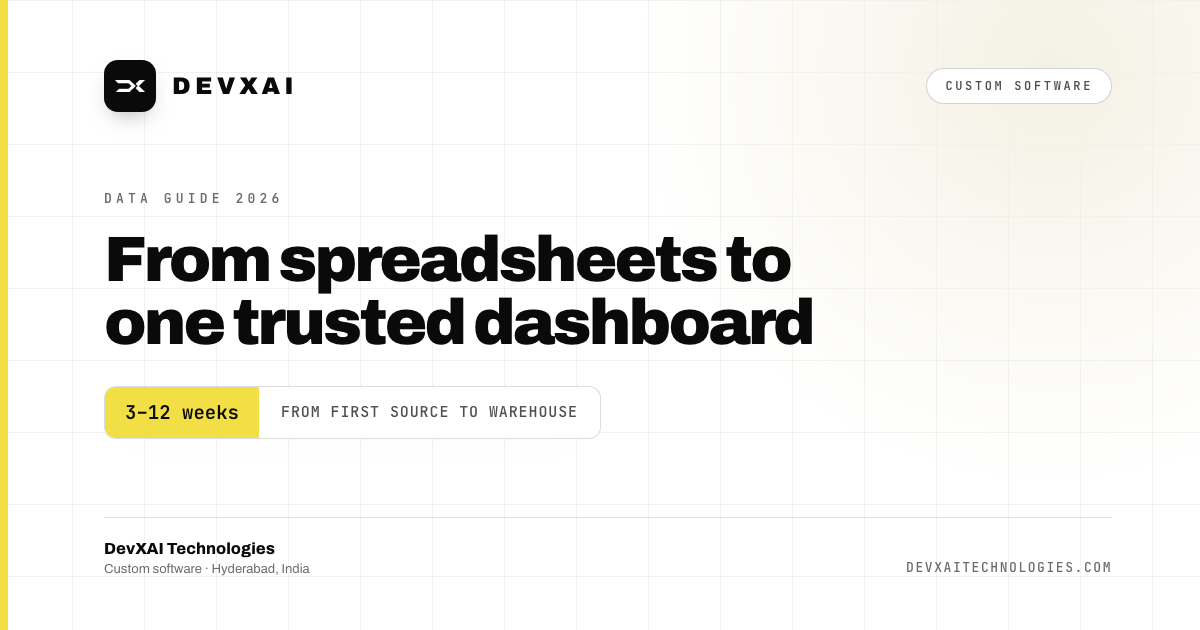
- At DevXAI it runs from ₹1,50,000 at a fixed price: 3–5 weeks for a single source, 6–12 weeks for multi-source consolidation.
- The hard part is not the tools. It is agreeing in writing what each metric means before building anything.
Every growing business reaches the same Monday meeting. Sales says revenue was one number, finance says another, and the ads team has a third. Each is right according to its own system. The next hour goes on reconciling exports instead of deciding anything.
That meeting is the clearest sign you need data engineering. This guide explains what it is in plain terms, what a sensible stack looks like for an Indian SME rather than a Silicon Valley giant, and what it costs and takes to build. The figures come from DevXAI's own data engineering service.
The short answer
| Stage | Typical scope | Timeline at DevXAI |
|---|---|---|
| Single-source pipeline and dashboard | One system (for example your ERP or Shopify) into a warehouse and one dashboard | 3–5 weeks |
| Multi-source consolidation | CRM, accounting, ads and operations joined in one warehouse with shared metric definitions | 6–12 weeks |
| Full data platform with real-time streams | Event and operational data streamed in, near-real-time dashboards | 12–20 weeks |
Fixed price from ₹1,50,000, excluding GST. Cloud compute runs in your own account at cost; BI licences such as Power BI or Looker are quoted separately.
Signs you have outgrown spreadsheets
- A weekly report takes someone hours to assemble from exports.
- Two systems disagree on how many customers you have.
- Decisions are made on figures that were right last Tuesday.
- Nobody trusts the analytics tool because it never matches the finance sheet.
- Engineers keep writing one-off scripts to answer management questions.
Data volume is rarely the trigger for an SME. Disagreement is.
The five-layer stack, sized for an SME
| Layer | What it does | Typical tools |
|---|---|---|
| 1. Sources | The systems you already run | Tally or Zoho Books, a CRM, Shopify or WooCommerce, Meta and Google Ads, your own app's database |
| 2. Ingestion | Copies data out of each source on a schedule or as events happen | Managed connectors, custom API extractors, change data capture |
| 3. Warehouse | One place where all of it lives, queryable together | PostgreSQL, BigQuery, Snowflake |
| 4. Modelling | Cleans, joins and defines metrics once, with tests | dbt, SQL, Python; orchestrated with Airflow or Prefect |
| 5. Dashboards | Shows the agreed metrics to the people who act on them | Looker Studio, Metabase, Power BI or a custom dashboard |
Layer 4 is where most of the value is and where most cheap projects cut corners. A dashboard wired straight to raw tables repeats every inconsistency in your source systems, just with better colours.
Choosing a warehouse without overbuying
- PostgreSQL: fine for moderate volumes, cheap to run, and many teams already know it. A good default when data fits comfortably on one server.
- BigQuery: serverless, billed per query and storage, very little to operate. Strong when usage is spiky and the team is small.
- Snowflake: excellent for larger organisations with many teams and workloads. Often more than an SME needs at the start.
Pick by data volume, who will run it, and how billing behaves when someone writes an expensive query. All three can be migrated between later if the modelling layer is clean.
The hard part: one definition per metric
"Revenue" can mean invoiced, collected, net of refunds, with or without GST, by order date or by delivery date. Each team's number is correct for its own definition. The fix is not technical. It is a short written document, signed off by finance, sales and operations, that defines each metric once, and every dashboard is then built from those definitions.
That is why DevXAI agrees metric definitions in writing before building dashboards, and why the staging review is a data-accuracy check against figures you already trust, such as last month's closed books, not just a look at the charts.
Data protection in India
Customer data in a warehouse is still personal data under the Digital Personal Data Protection Act. Keep the infrastructure in your own cloud account, restrict who can query personal fields, mask what analysts do not need, and document access. Our DPDP Act checklist covers the obligations in more detail.
Where AI fits
Asking questions of your data in plain English, through an AI assistant or an agent, is now realistic. But an AI is only as reliable as the tables it queries. Teams that bolt a chatbot onto messy exports get confident wrong answers. A governed data layer first, then AI on top, is the order that works.
How to start
- List the five questions management asks most often that take too long to answer.
- For each, write down which systems hold the data and who owns each system.
- Pick the one with the highest value and fewest sources. Build that first, as a single-source pipeline, and prove the number matches.
DEVXAI · DATA ENGINEERING
One number for revenue, and everyone agrees on it.
Pipelines, a governed warehouse in your own cloud account and dashboards built from written metric definitions. Fixed price from ₹1,50,000.
Frequently asked questions
What does a data engineering project cost in India?
At DevXAI, data engineering starts from ₹1,50,000 at a fixed price, excluding GST. A single-source pipeline with one dashboard typically takes three to five weeks; consolidating several sources into a warehouse takes six to twelve. Cloud compute and BI licences run in your own account and are separate.
Do small businesses need a data warehouse?
Not always. If all your data lives in one system with good built-in reports, use those. A warehouse earns its cost when numbers must be combined from several systems, such as sales, ads, accounting and operations, and teams keep disagreeing about which figure is right.
Which is better: BigQuery, Snowflake or PostgreSQL?
For many Indian SMEs, PostgreSQL or BigQuery is enough. PostgreSQL suits moderate data volumes and teams that already run it; BigQuery suits pay-per-query analytics with little to manage. Snowflake suits larger multi-team setups. Choose by data volume, team skills and how costs are billed, not by brand.
How do we know dashboard numbers are correct?
Agree a written definition for every metric before building, test the pipelines, and validate the dashboard against figures you already trust, such as last month's closed books. If a metric cannot be traced back to its source query, it should not be published.
Can AI tools answer questions from our business data?
Yes, once the data is clean and modelled. AI assistants that query business data are only as reliable as the tables underneath, so a governed data layer is usually the first step before adding natural-language questions on top.
Topics
Found this useful?
Share it with your network.