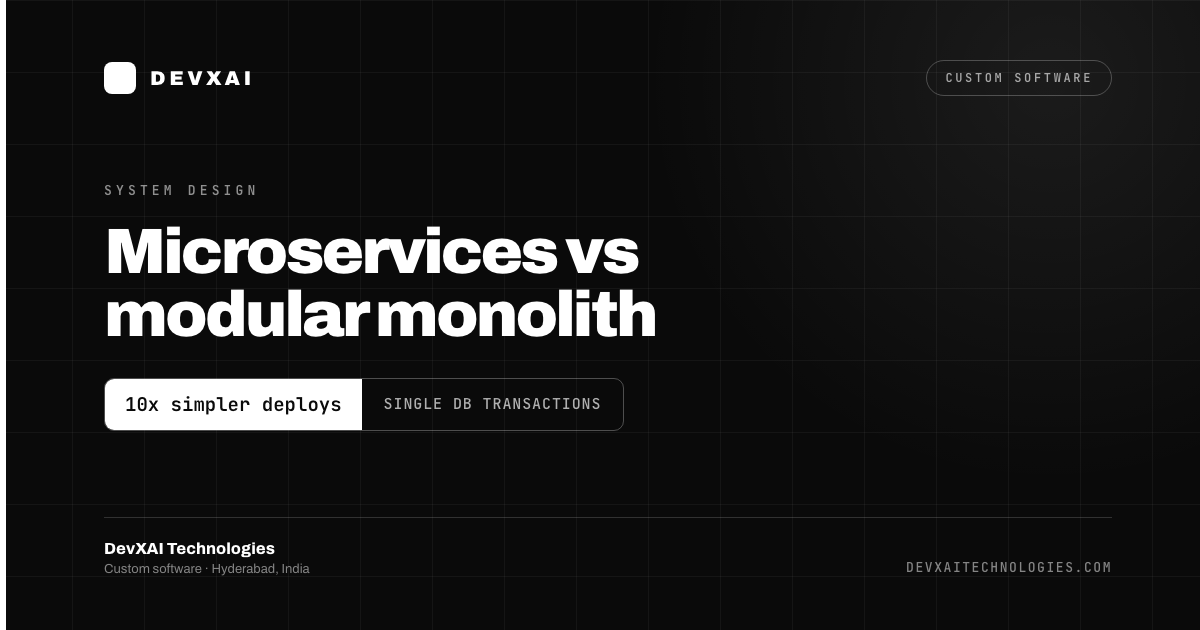
Between 2018 and 2023, thousands of early-stage startups adopted microservices architectures because Google, Netflix, and Uber did. By 2026, the pendulum has swung back with force. From Amazon Prime Video discarding serverless microservices to save 90% on cloud compute to fintech startups consolidating twenty services back into one, engineering leaders have rediscovered the modular monolith.
At DevXAI, we frequently inherit backends where five junior engineers spend 40% of their sprints debugging Kubernetes manifests, distributed tracing failures, and gRPC timeouts instead of shipping features. Here is how growing tech companies in India can scale to millions of monthly transactions without paying the microservice tax.
The Hidden Costs of Premature Distribution
When you break an application into ten separate microservices, you trade in-memory function calls for network hops:
- Loss of ACID Transactions: In a single database, updating an order status and deducting inventory is wrapped in a rock-solid
BEGIN ... COMMITblock. In microservices, you must implement the Saga pattern, two-phase commits, and compensatory transactions to handle partial network drops. - DevOps Overhead: One application requires one build pipeline and one deployment script. Ten microservices require service meshes, API gateways, secret syncing across repositories, and distributed log aggregators (like Datadog), inflating monthly cloud bills.
- Refactoring Paralysis: Early-stage business models evolve every week. Refactoring a boundary inside a single codebase is a 10-minute IDE rename. Refactoring across five microservices requires deprecation windows, versioned APIs, and coordinated cross-repo rollouts.
What a Real Modular Monolith Looks Like
A modular monolith is NOT a "spaghetti monolith" where every file imports every other file. It is a strictly structured codebase divided into bounded contexts:
src/
├── modules/
│   ├── identity/        # Auth, MFA, users, permissions
│   │   ├── internal/    # Private DB models & helper functions
│   │   └── index.ts     # PUBLIC API: only exported functions/types
│   ├── billing/         # Razorpay webhooks, invoices, subscriptions
│   │   ├── internal/
│   │   └── index.ts
│   ├── logistics/       # Tracking, dispatch, inventory
│   │   ├── internal/
│   │   └── index.ts
│   └── notifications/   # Email, SMS, WhatsApp triggers
└── app.ts               # HTTP routing & dependency wiring
Rule: Modules Communicate Through Interfaces, Never Shared Tables
The single rule that prevents a modular monolith from becoming a tangled mess is: Module A never queries Module B's database tables directly.
If the Billing module needs user contact details, it calls identity.getUserContact(userId). The identity module owns its schema. If identity schema changes, billing's contract remains untouched. If your team ever genuinely needs to split billing into its own microservice three years later, you simply replace the in-process function call with an HTTP or gRPC client. You retain 100% of the optionality without suffering the pain early.
SYSTEM DESIGN & ENGINEERING
Architected for scale from day one
DevXAI designs robust, maintainable backends and enterprise architectures with zero technical debt, delivered within fixed-price contracts.
Explore Cloud & API Engineering or Request a Technical Consultation.
The Milestone to Microservices
Do not break out a microservice until you have:
- More than 30 full-time engineers divided into autonomous squads who frequently block each other's deployments.
- A single service with asymmetric compute requirements (e.g., CPU-heavy image compression or GPU inference) that starves the main web process.
- Hard regulatory boundaries (such as isolating cardholder data environments for PCI-DSS compliance).
Topics

TEAM DEVXAI
Written and published by the engineering, product design, and AI systems team at DevXAI Technologies.
Found this useful?
Share it with your network.