Buy first. Build second. For most Indian SMEs, off-the-shelf software is right until the process you are automating is the thing customers pay you for. Across the builds we have quoted from Hyderabad, the crossover sits between 15 and 40 people on the process, earlier if a manual workaround eats salaried hours daily.
Search custom software development India and you get ten agency pages that all conclude you should hire an agency. This one tells you when not to.
Below: a six-test framework, a worked five-year cost model at 40 seats, the hybrid path that fits most ₹5 crore to ₹50 crore businesses, and the cases where buying wins outright.
The short answer
| Your situation | What to do | Five-year cost band |
|---|---|---|
| Under 15 people, standard sales, billing and books | Buy. A suite plus a good CA | ₹3,00,000 to ₹9,00,000 |
| 15 to 40 people, one process that is genuinely yours | Hybrid. Buy the ledger, build the workflow layer on its API | ₹12,00,000 to ₹28,00,000 |
| 40+ people on the process, four or more systems to integrate | Build. Custom platform plus annual maintenance | ₹35,00,000 to ₹60,00,000 |
| Customer PII at scale, real DPDP exposure | Build or self-host. Own the database | ₹20,00,000 upwards |
| Process changes materially every quarter | Build. Configuration limits will bite inside a year | ₹18,00,000 upwards |
| You want a CRM, payroll, HRMS or accounting system | Buy. Do not build these | ₹2,00,000 to ₹8,00,000 |
Those are the ranges DevXAI quotes for Indian SMEs, excluding the 18% GST on IT services, and they assume you budget for hosting and maintenance rather than pretending a system runs itself.
Is the process your moat, or is it a commodity?
Every build-versus-buy argument collapses into one question. Does the way you run this process win you business, or is it how ten thousand other Indian companies run it?
Payroll is a commodity. GST return preparation is a commodity. Your sales pipeline almost certainly is. But the way a Hyderabad diagnostics chain routes samples to the right lab before they degrade, or a Gachibowli operator prices a part-truckload lane against live return cargo, is not. That is the moat, and the only part worth building.
The process is your moat when
- You lose deals when it is slow and win them when it is fast.
- Competitors do it differently and worse, and you can explain how in a sentence.
- Pricing, routing or scheduling decisions depend on data only you hold.
It is a commodity when
- The complaint is about too many fields, not about work the software cannot do.
- A regulator defines the output format, not you. GST returns, TDS, EPF, ESI.
- You would happily change your process to match the software if it meant less work.
That last point is the one people skip. A large share of "this has to be custom" enquiries are really "this process needs to change and nobody wants to say so". Off-the-shelf software carries an opinion about how the work should be done, formed across thousands of companies. Sometimes that opinion beats yours.
Six tests to run before you commission anything
- Headcount on the process. Count people who touch it daily, not total employees. Under 15 points to buy, 15 to 40 to hybrid, 40+ to build.
- Integration count. Three systems or fewer and most suites cope natively. Four or more (Tally, a warehouse system, a courier API, a payment gateway) and you are buying a suite and funding an integration project on top.
- Cost of the workaround, in rupees. Price the manual labour the software removes. If you cannot state that number, you are not ready to buy anything.
- Data ownership and exit. Ask every vendor: can I pull a complete relational export, custom fields and attachments included, on demand, without a support ticket? A per-module CSV means you do not own your data, you rent access to it.
- Compliance exposure. Volume of personal data, who sees it, where it sits. Run the shortlist against a DPDP Act compliance checklist before you sign, not after a notice.
- Rate of change. If the process changed materially twice in 18 months, configuration screens run out of road inside a year and you pay a partner to script inside someone else's product.
Four or more tests pointing one way settles it. A three-three split means the hybrid path below, where most businesses land.
Test three ends arguments: it produces a number, not an opinion. Three coordinators spending 90 minutes a day rekeying orders between a marketplace panel and Tally, on ₹35,000 a month against a 176-hour month, costs about ₹199 an hour each. That is ₹19,700 a month, ₹2,36,000 a year, ₹11,80,000 over five years, before one wrong SKU. Put that on the same slide as the build quote or the comparison is dishonest. Sometimes it justifies a ₹3,00,000 script rather than a platform, the split covered in AI automation for Indian businesses.
FREE 30-MINUTE AUDIT
Not sure whether to build or buy? Get a straight answer in 30 minutes
Send the process you want fixed, your seat count and the systems it must talk to. We run the six tests with you on a call. If the honest answer is Zoho, Tally or Odoo, we say so and you will not hear from us again.
Custom software development India: the five-year cost, worked
Most comparisons fail because they set a one-time build price against a monthly subscription. Here is one 40-user process costed both ways over five years, assumptions stated so you can substitute your own.
- 40 users, five years, excluding the 18% GST on IT services. That GST is input credit if you are registered, a hard cost if you are not.
- Per-seat suite at an effective ₹1,500 per user per month, escalating 8% a year at renewal.
- Custom side: ₹18,00,000 for the build, discovery costed separately, maintenance ₹25,000 a month from month 13. Year one is warranty.
- Cloud in an Indian region at about ₹10,000 a month: managed Postgres, storage, backups.
- Internal admin time is roughly equal on both sides and is out of both columns.
| Line item | Per-seat SaaS | Custom build |
|---|---|---|
| Year 1 licence or build | ₹7,20,000 | ₹18,00,000 |
| Years 2 to 5 licence or AMC | ₹35,04,000 | ₹12,00,000 |
| Discovery and design | Not applicable | ₹2,00,000 |
| Implementation and configuration | ₹3,00,000 | Included |
| Bending it to your process | ₹5,00,000 | ₹4,00,000 in change requests |
| Integrations and connectors | ₹2,50,000 | ₹2,00,000 |
| Hosting and third-party services | Included | ₹6,00,000 |
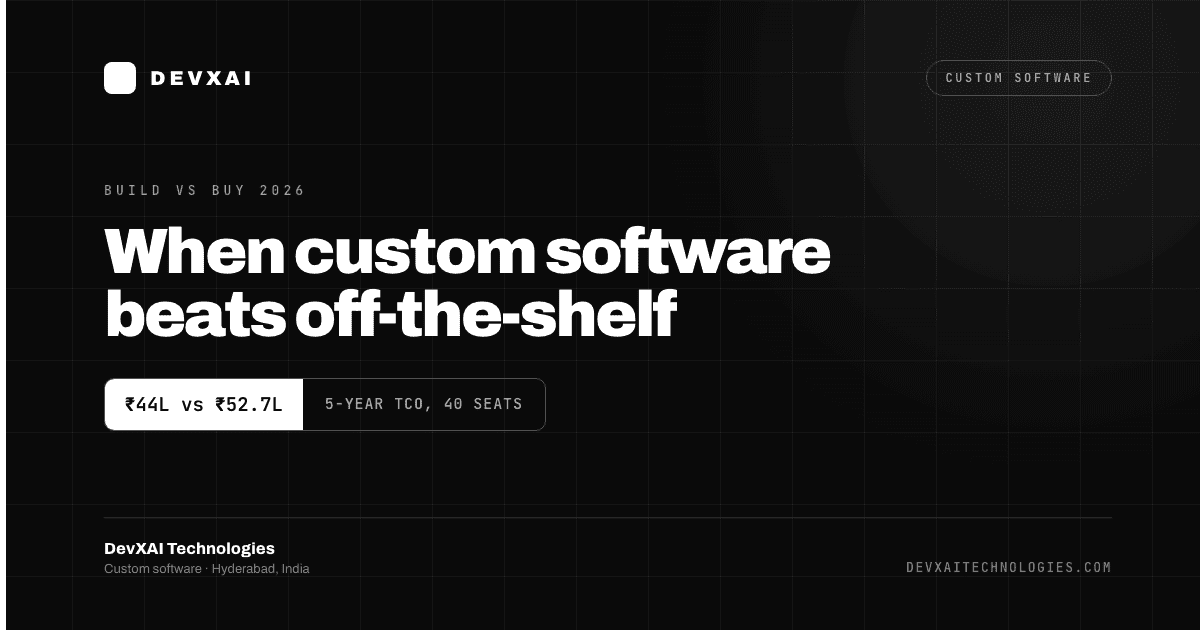
| Five-year total | ₹52,74,000 | ₹44,00,000 |
Custom wins by ₹8,74,000, about ₹14,500 a month. The two five-year totals are roughly USD 50,000 and USD 60,000 at current rates. The uncomfortable part is that the gap is thinner than it looks. A build that slips two quarters, or a scope that grows 30% because nobody wrote the process down first, erases it. The subscription number is near certain. The build number is an estimate with execution risk, and you carry it.
Change one assumption and it inverts. At 12 seats the five-year licence line falls to about ₹12,70,000 while the build barely moves, because a build is priced by process complexity, not by how many people log in. That settles most arguments in companies under 20 people. The same arithmetic drives platform pricing generally, broken down in website development cost in Hyderabad.
Maintenance is not optional. Budget 15 to 20 percent of build cost a year. A custom system with no maintenance budget is a liability with an 18-month fuse, and it fails as an expired certificate or a gateway dropping the API version you integrated against. That is what a care plan prevents.
The hybrid path most Indian SMEs should actually take
Build versus buy is the wrong framing for the middle of the market. The real question is which layer to buy and which to build.
Buy the ledger. Accounting, GST returns, statutory payroll and the audit trail are commodity problems with regulator-defined outputs, solved by Tally, Zoho Books, Odoo and SAP Business One under scrutiny you cannot replicate. Build the layer above: the workflow your staff live in all day.
- The accounting product stays the system of record for vouchers, invoices and books.
- Your custom application owns orders, jobs, dispatch, tickets and approvals, in a database you control.
- The two talk over an API. TallyPrime can be driven over its XML gateway on the local network, Zoho Books and Odoo expose REST and RPC APIs, SAP Business One has a Service Layer. Confirm what your licence and version support first.
- Nothing is keyed twice. A dispatched order posts its invoice and hits the books in minutes.
This is the pattern behind most of the ERP and internal systems work that comes through the office in Hyderabad, and it has two properties a pure build does not. Your accountant never changes tools, and if the custom layer is retired the books survive. The integration is the hard part, not the screens, which is why API and cloud work is the largest line in a hybrid quote.
What changes because you are running this in India
Five constraints reshape this decision here. Every one would be irrelevant advice to a business in the United States, and the last two are where imported software fails hardest.
- GST and e-invoicing. IT services carry 18% GST. E-invoicing through the IRP applies above a turnover threshold that keeps ratcheting down, so check the current notification with your CA, not a blog post. If you are near it, e-invoicing and e-way bills belong in the requirements document.
- Tally is your accountant's lock-in, not yours. Your CA's team is fast in Tally and slow everywhere else. Ship a system that cannot hand Tally a clean import and your accountant quietly keeps a second set of books. Two quarters later they disagree and nobody knows which is right.
- MSME and Udyam realities. If you buy from Udyam-registered micro and small suppliers, payment timelines now carry income-tax consequences. Vendor ageing and a payment-due alert beat another dashboard. Confirm the provision with your CA.
- Regional-language operations. Field staff in Vijayawada, Visakhapatnam or a Patancheru plant type in Telugu or Hindi even when the interface is English. Allow Unicode free text in notes and names, keep dropdowns and status codes in English so reports aggregate, and never make a regional-language field a join key.
- Shared devices and weak networks. One Android handset per shift, passed between operators, is normal on Indian shop floors. Design for PIN switching, log actions against the user not the device, and expect 4G to die inside warehouses, so field tools must sync offline. Test on a real ₹8,000 phone, not an iPhone in Madhapur on office wifi.
This is not legal or tax advice. Take the GST, DPDP and MSME points to your CA before they become contract clauses. One advantage of building here: IST covers the working day for teams in Bengaluru, Chennai, Mumbai and Pune, and a request from a plant in Medchal gets answered the same shift, not next business day in another timezone.
You should buy, not build. Read this twice
We turn down roughly one in four enquiries asking for a custom ERP, because the honest recommendation is a subscription. Here is when that is you.
- Fewer than 15 people touch the process. The arithmetic is unambiguous. Buy the suite, spend the difference on sales.
- What you want is a CRM, accounting package, payroll system or HRMS. Solved, regulated, maintained by teams larger than your company. Building one is a hobby that bills hourly.
- Nobody internally owns the decision. If no one person can approve a screen change in one meeting, the build drifts and you pay for the drift.
- You cannot fund maintenance. If ₹20,000 to ₹30,000 a month of AMC is not in next year's budget, do not start. An unmaintained system is worse than the spreadsheet it replaced, because people trust it.
- The process is not written down. Software makes an undocumented process faster, permanent and harder to change. Plenty of these enquiries end with the process fixed and no software bought.
- The quote is suspiciously cheap. If an agency in Madhapur, Kondapur or Banjara Hills offers a complete ERP with a mobile app for ₹3,50,000, that is a template with your logo on it. Look at delivered project work and ask which parts were built for that client.
The sharpest version: if your advantage is your sales team or your supply relationships rather than your operating process, custom software will not move revenue. It improves reporting. Different purchases, and only one is urgent.
FIXED-PRICE QUOTE
Get a fixed price for the build, and an honest number for the alternative
Send your process one-pager, seat count and integration list. We come back within one working day with a scope, a timeline and a fixed price in INR, plus what the off-the-shelf route costs over five years so you compare like with like.
Frequently asked questions
Is custom software development India cheaper than paying for SaaS?
Only above a certain seat count. In our modelling at 40 users over five years, a per-seat suite lands near ₹52,74,000 and a custom build near ₹44,00,000. At 12 users the five-year licence line drops to about ₹12,70,000 while the build barely moves. Count seats before anything else.
How long does a custom build take for a mid-sized Indian business?
Budget 14 to 22 weeks from signed scope to production for a single-process platform with two or three integrations. Discovery and data migration take longer than people expect. Anyone quoting six weeks for a full ERP is selling a template, and the difference shows up in month four.
Can you start on Zoho or Odoo and move to custom later?
Yes, and it is usually the cheapest path. Run the process on the suite for two to four quarters so the requirement stops changing weekly. Insist on a full relational export in the contract. Then build the workflow layer over the suite API rather than replacing the ledger.
What does an AMC actually cover, and can you skip it?
We price annual maintenance at 15 to 20 percent of build cost a year. It covers security patching, dependency and OS upgrades, cloud monitoring, bug fixes and a fixed pool of small changes. Skipping it is the single most common reason a two-year-old custom system becomes unusable.
Do you own the source code and the database?
You should own both outright, assigned on final payment, with the repository and cloud account in your company name from day one. Get it in the contract, not the proposal. If a vendor hosts your production database in their own AWS account, you have bought a subscription with extra steps.
What to do this week
Four steps, in order, before you sit through a vendor demo.
- Write the process on one page. Trigger, steps, decision points, exceptions, owners. If it will not fit, you have found the real problem.
- Count two numbers: people who touch it daily, and systems it must exchange data with.
- Price the workaround in rupees a year using the method above.
- Take that page to one SaaS partner and one build partner. Identical brief, both costed over five years including maintenance. The answer becomes obvious.
How scoping and pricing work is set out on the process page, and the shortest route to an answer is a 30-minute call from the contact page. Businesses in Hyderabad and across India, from HITEC City to the Financial District, get the same rule: buy what is common, build what is yours.
Topics

TEAM DEVXAI
Written and published by the engineering, product design, and AI systems team at DevXAI Technologies.
Found this useful?
Share it with your network.