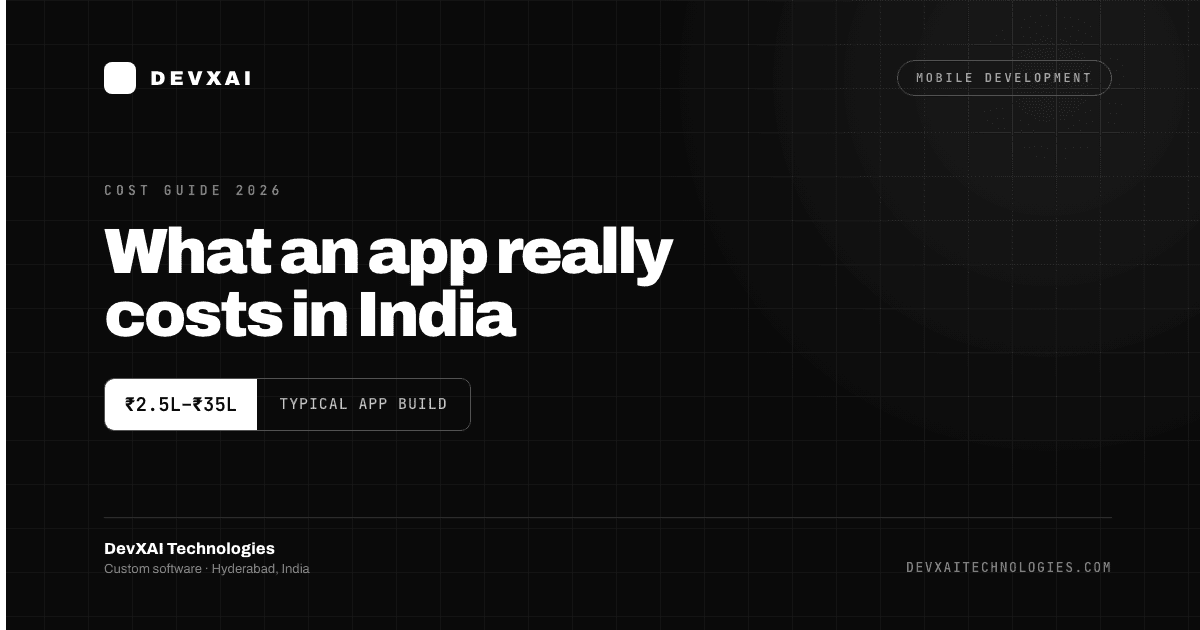
Mobile app development cost in India in 2026 runs from ₹2,50,000 for a simple single-purpose app to ₹35,00,000 or more for a two-sided marketplace, with most funded business apps landing between ₹6,00,000 and ₹14,00,000. Cross-platform builds sit at the lower end; native iOS plus native Android costs roughly 1.6× to 1.9× the same scope.
Those are build numbers only. The figure that surprises people is year two: developer accounts, cloud, crash monitoring, store compliance updates and OS churn typically add 15% to 20% of the original build cost every year, forever.
Below are the bands, what moves them, and where you should not spend the money at all.
The short answer
| App type | Build cost (INR) | Timeline |
|---|---|---|
| Simple utility or content app (8–12 screens, no payments) | ₹2,50,000 – ₹6,00,000 | 6–10 weeks |
| Business app (accounts, backend, payments, admin panel) | ₹6,00,000 – ₹14,00,000 | 12–18 weeks |
| Marketplace or aggregator (two-sided, live tracking, payouts) | ₹14,00,000 – ₹35,00,000 | 20–30 weeks |
| Social or UGC app (feed, media pipeline, moderation) | ₹18,00,000 – ₹45,00,000 | 22–34 weeks |
| Fintech-grade (KYC, ledger, audit trail, security review) | ₹30,00,000 – ₹75,00,000 | 28–40 weeks |
| Native iOS + native Android instead of cross-platform | Add 60% – 90% | Add 4–8 weeks |
| Running the app after launch | 15% – 20% of build, per year | Ongoing |
Those are the bands we quote out of Hyderabad in 2026. A ₹12,00,000 build is roughly US$12,500 at August 2026 rates. Add 18% GST on top of every figure above.
What mobile app development cost in India is actually made of
An app quote is engineer-hours plus a fixed set of platform bills. Budget ₹1,200 to ₹2,200 per hour for a mid-level mobile engineer in Hyderabad in 2026, and ₹2,500 to ₹4,000 for a senior iOS or Android specialist. Quotes out of Bengaluru and Mumbai land 20% to 40% above that for the same seniority; Vijayawada and Visakhapatnam land below it.
The hours split more evenly than most founders expect:
- Product and UX design, 15–20%. Wireframes, a clickable prototype, a component library. Skipping this does not save money; it moves the cost into rework during development.
- Mobile engineering, 35–45%. Screens, state management, offline behaviour, platform plumbing.
- Backend and APIs, 20–30%. Auth, business logic, admin panel, payments, notifications — the APIs and cloud layer.
- QA and release engineering, 12–18%. Device testing, store submission, crash triage in the first two weeks.
- Project management, 8–10%. If a quote shows nothing here, it is hidden inside the other lines.
Anything quoted below roughly ₹2,00,000 for an app with a login and a server is a template rebrand or a fixed fee that gets repriced at the first change request. Honest ₹1,50,000 apps exist. They have no backend, no payments and no user accounts.
Native, Flutter or React Native: what each choice costs
Cross-platform is the default recommendation in India for a good reason. One Flutter codebase covers iOS and Android from a single team, removing 40% to 50% of the engineering hours compared with two native builds of the same scope. For a booking app, a catalogue, a service marketplace or an internal tool, that is the right trade.
It is the wrong trade more often than the internet admits:
| Your situation | Choose | Cost effect |
|---|---|---|
| Standard UI, two platforms, budget under ₹15,00,000 | Flutter | Baseline |
| Existing React or TypeScript web team reusing logic | React Native | Baseline, lower onboarding cost |
| Deep hardware: BLE, NFC, CarPlay, HealthKit, custom camera | Native Swift + Kotlin | +60–90%, fewer surprises |
| Fintech with attestation, root detection, secure key storage | Native, or Flutter plus native security modules | +25–60% |
| iOS-only premium audience, no Android plan for 12 months | Native Swift | −35% versus building both |
| You plan to hire an in-house team in Hyderabad | Flutter | Cheaper, faster hiring pool |
| Real-time video, AR, or on-device ML | Native | +50–100% |
That hiring row is a real cost and nobody prices it. A senior Swift engineer in HITEC City takes eight to twelve weeks to hire and costs meaningfully more per year than a Flutter engineer of the same experience, because the Hyderabad and Bengaluru talent pool skews cross-platform. If your three-year plan is to take the app in-house, the stack you pick today sets your salary bill. Choose the stack your future team exists in.
If your product moves money, do not let anyone tell you Flutter halves the cost. It halves the UI cost. Four things stay native or backend work either way, and that is where the budget goes:
- Security review of the payment and auth paths.
- Device attestation and root detection.
- Secure key storage in Keychain and Android Keystore.
- A server-side audit trail for every money movement.
The payment side is covered separately in this guide to UPI payment gateway integration in India.
FIXED-PRICE QUOTE
Get a real number for your app, not a range
Send us your screens, your must-have integrations and your launch date. You get back a scoped, fixed-price estimate in INR within one working day, with the platform bills listed separately so nothing appears later.
The backend and infrastructure costs nobody puts in the quote
The app is the visible half. The invisible half bills monthly, forever. For an early-stage Indian app on AWS ap-south-1 (Mumbai) under 10,000 monthly active users, budget ₹8,000 to ₹45,000 a month across compute, managed Postgres, object storage and CDN. At 100,000 monthly actives with media uploads that band moves to ₹60,000 to ₹2,50,000.
- SMS OTP. Roughly ₹0.12 to ₹0.25 per message plus DLT template registration under TRAI rules. At 40,000 logins a month that is a real bill; price WhatsApp OTP against it.
- Maps. Google Maps Platform bills per request, and a tracking app can go from free tier to ₹30,000 a month in one growth quarter. Price MapmyIndia and Ola Maps for Indian coverage.
- Crash and performance monitoring. Firebase Crashlytics is free; Sentry with useful retention is ₹2,500 to ₹15,000 a month.
- Push notifications. FCM and APNs cost nothing to send. The cost is the engineering to segment and measure them, plus a tool like OneSignal once marketing gets involved.
- Transactional email and CI. Amazon SES or Brevo, ₹1,500 to ₹8,000 a month; Codemagic, Bitrise or Fastlane, ₹0 to ₹12,000.
Developer accounts are small and non-negotiable. The Apple Developer Program is US$99 per year — let it lapse and your app leaves the App Store. Google Play registration is a one-time US$25. Register it as an organisation rather than a person: personal accounts opened since late 2023 must run a closed test for a fixed period before production release, while accounts registered to a legal business entity are exempt. Check the current Play Console policy, because the tester count has changed before.
Year two: compliance updates, OS churn and the maintenance bill
Budget 15% to 20% of build cost per year to keep an app alive. That is not a retainer for new features. That is the price of standing still.
- Target API level churn. Google raises the minimum target API level every year. Miss it and you cannot ship updates at all. Apple periodically requires builds against a recent SDK. Each cycle is one to three engineer-weeks of upgrade and regression work.
- Store policy forms. Play Data Safety and Apple privacy labels must match what your SDKs actually collect. One analytics SDK added by a marketer can trigger a rejection.
- SDK deprecations and Play vitals. Gateways and auth libraries force upgrades on their schedule, and excessive ANRs or crashes get an app demoted in Play rankings.
- DPDP Act, 2023 obligations. Consent capture, deletion on request and breach notification are ongoing engineering, not a one-time checkbox.
A ₹10,00,000 app therefore carries a ₹1,50,000 to ₹2,00,000 annual floor before a single new feature. Our care plans exist because most teams discover this in month fourteen, with nobody left who remembers the codebase.
Why Indian device reality changes the estimate
This is the section a US-written cost guide gets wrong. A large share of your users in India will open the app on a ₹8,000 to ₹14,000 Android handset with 2GB to 4GB of RAM, near-full storage, an aggressive battery manager that kills background work, and a 4G connection that drops in lifts, basements and most of tier-2 India.
That reality is a line item, not a design opinion. It adds roughly 15% to 25% to engineering and QA on a consumer app:
- Bundle size budget. Users on full phones uninstall the biggest app first. Holding an Android App Bundle near 25 MB means auditing dependencies and splitting assets instead of adding libraries freely.
- Cold start under 2.5 seconds on a low-end handset, not on the ₹1,20,000 phone in the developer's pocket. Deferred initialisation and lazy module loading are real work.
- Offline-first data. A local queue that survives an app kill, replays writes and resolves conflicts. On a delivery, field-sales or attendance app this is often 20% of the mobile engineering effort by itself.
- Image pipeline. Server-side resizing and WebP delivery, not the 4 MB JPEG a designer exported.
- OEM battery management. Xiaomi, Vivo, Oppo and Realme each kill background services differently. Push-triggered sync beats background schedulers.
- Language. Hindi and Telugu strings expand layouts. Retrofitting localisation after launch costs more than designing for it.
Practical consequence: buy three cheap handsets and test on them. A simulator on a MacBook in Madhapur will never show the six-second cold start your Vijayawada user sees. Teams that skip this ship an app with warm reviews from the founder's friends and a rating under three stars from everyone else.
When you should not build an app at all
Roughly a third of the "we need a mobile app" enquiries that reach us from Gachibowli and the Financial District should not become apps this year. Skip the app if:
- You have not validated demand. A fast mobile web page, a WhatsApp Business number and a UPI payment link test the same hypothesis for ₹60,000 to ₹2,00,000. If nobody buys through that, an app will not fix it. The website development cost in Hyderabad breakdown is the cheaper starting point.
- It is an internal tool for under 100 staff. A responsive web app your team opens in Chrome costs a fraction of two store builds and updates without a review queue. No stores, no OS churn, no annual fee.
- Users would open it twice a year. Insurance renewals, annual filings, event registrations. Nobody keeps that app installed.
- Your real problem is operations. If orders are lost in WhatsApp groups and stock lives in Excel, an app puts a clean front on a broken process. An ERP or operations system is the honest answer, and a different budget.
If you are pre-revenue, an MVP scoped to one workflow beats a full build every time — see MVP development in Hyderabad for what belongs in a first version.
Milestones, GST and how payment should be structured
Never pay a mobile project 50% upfront and 50% on delivery. That structure gives both sides the wrong incentives and gives you no exit if the work drifts. Tie money to artefacts you can open and inspect.
| Milestone | Share | What you receive |
|---|---|---|
| Kickoff | 15% | Signed scope, screen list, integration list |
| Design sign-off | 25% | Clickable prototype of every screen |
| Internal beta | 25% | Installable TestFlight and Play internal-test builds |
| Store submission | 20% | Both apps submitted, source in your Git organisation |
| Post-launch | 15% | 30 days after go-live, crash rate agreed in writing |
Three clauses worth insisting on:
- Source code and cloud accounts in your name from day one, not handed over at the end.
- Store listings owned by your company's developer accounts, never the agency's.
- A named crash-free-sessions target on the final milestone.
The delivery process page shows what each gate produces.
On tax: software and IT services in India attract 18% GST, charged on top of the quoted fee and recoverable as input credit if you are GST-registered. If your vendor is Udyam-registered as an MSME, statutory timelines apply to what you owe them under the MSMED Act — confirm the current position with your CA before setting 90-day terms. This is not legal or tax advice. Check the current notification for anything you plan to rely on.
One thing IST buys you: a Hyderabad team overlaps with Europe for most of the working day and with US East each evening, so daily standups with overseas founders need no night shift. If your co-founders are in London or New York, that overlap beats a cheaper rate from a timezone with none.
TALK TO AN ENGINEER
Not sure whether you need an app or a web app
Thirty minutes with someone who has shipped both. We will tell you if the cheaper option is right for you, including when that means not hiring an agency at all.
Book a free consultation with our mobile product team.
Frequently asked questions
How much does mobile app development cost in India in 2026?
A simple single-purpose app costs ₹2,50,000 to ₹6,00,000. A business app with accounts, a backend and payments costs ₹6,00,000 to ₹14,00,000. A two-sided marketplace runs ₹14,00,000 to ₹35,00,000, and a fintech-grade product with KYC and a ledger starts around ₹30,00,000. Add 18% GST and 15% to 20% of the build cost annually to run it.
Is Flutter genuinely cheaper than building native iOS and Android?
Yes, for standard app categories. One Flutter codebase removes 40% to 50% of the engineering hours versus two native builds of the same scope. The saving shrinks toward zero when the app needs deep hardware access, device attestation, on-device machine learning or heavy real-time video, because that work has to be written natively regardless.
What does it cost to maintain an app after launch?
Budget 15% to 20% of the build cost per year before any new features. That covers annual target API level upgrades, store policy and privacy form changes, third-party SDK deprecations, crash triage against Play Console vitals, and cloud bills. A ₹10,00,000 app has a realistic floor of ₹1,50,000 to ₹2,00,000 a year.
Do I need both an Apple and a Google Play developer account?
You need one for each store you publish to. Apple's Developer Program is US$99 per year and lapsing it removes your app from the App Store. Google Play registration is a one-time US$25. Register both in your company's name, never the agency's, and keep the login with a director rather than a developer.
How long does it take to build and launch an app in India?
Six to ten weeks for a simple app, twelve to eighteen for a business app with payments, and twenty to thirty for a marketplace. Add one to two weeks for store review and the fixes reviewers ask for. Personal Google Play accounts also face a closed testing period before production, so register as an organisation in week one.
What to do next
Write down three things before you talk to any vendor in Hyderabad, Bengaluru, Pune or Chennai: the exact list of screens, the integrations you cannot launch without, and the date the app must be live. Those three inputs turn a vague ₹5,00,000-to-₹25,00,000 conversation into a fixed number in under a day. Vendors who cannot quote against that list are guessing, and you pay for the guess.
Then price the cheapest version that proves the idea, ship it, watch the analytics for six weeks, and spend the rest of the budget on what the data says. Send your screen list and launch date through the contact form for a scoped estimate within one working day.
Topics

TEAM DEVXAI
Written and published by the engineering, product design, and AI systems team at DevXAI Technologies.
Found this useful?
Share it with your network.