Key takeaways
- SEO wins the ranked link, AEO wins the direct answer, GEO wins the mention inside an AI-generated answer. Each one builds on the one before.
- AI assistants mostly retrieve from the same web search indexes. If you do not rank or are not crawlable, you are rarely cited.
- What moves citations: answer-first pages, clear entity data, original facts (prices, timelines, specifics), and being mentioned by sources other than yourself.
- llms.txt is cheap and harmless but unproven. Treat it as a convenience, not a strategy.
A buyer in 2026 who wants a software company, a content studio or a tax answer often never sees ten blue links. They ask ChatGPT, Gemini, Perplexity or Copilot, or read the AI Overview at the top of Google, and act on the answer. If your business is not in that answer, you were not considered.
That has produced two new acronyms next to SEO. This guide explains what each one means without the hype, what the evidence says actually changes whether an AI names you, and the checklist we apply to DevXAI's own three brands: this site, Stay Loud Studio and myFinance Wisdom.
The short answer
| SEO | AEO | GEO | |
|---|---|---|---|
| Goal | A ranked link | The direct answer | A mention or citation in an AI answer |
| Where it shows | Search results | Featured snippets, People Also Ask, voice assistants | ChatGPT, Gemini, Perplexity, Copilot, Google AI Overviews and AI Mode |
| Unit of success | A page | A passage | An entity (your brand) plus a passage |
| Main levers | Crawlability, relevance, links, speed | Answer-first writing, FAQs, tables, schema | Entity clarity, original facts, third-party mentions, freshness |
| How to measure | Rankings, clicks | Snippet ownership | Prompt tracking, AI referral traffic |
How AI assistants actually choose what to cite
It helps to know the mechanics, because most bad GEO advice comes from imagining a secret AI ranking system. In practice, when an assistant answers a question about the current world, it usually:
- Rewrites the question into searches, often several, run against a web index (Bing for many assistants, Google's own index for Gemini and AI Overviews, or the assistant's own crawler).
- Fetches a handful of top results and reads them.
- Extracts passages that directly answer the question.
- Writes an answer and cites the pages it drew from.
Two things follow. First, you cannot skip SEO: a page that does not rank for the underlying searches is never read. Second, ranking is not enough: the assistant picks the page whose passages state the answer most clearly and specifically. That is where AEO and GEO add something.
A third source matters for brand questions ("best content studio in Hyderabad"): what the model learned during training, which comes from how often and how consistently your business is described across the web. That is why mentions on other sites carry so much weight.
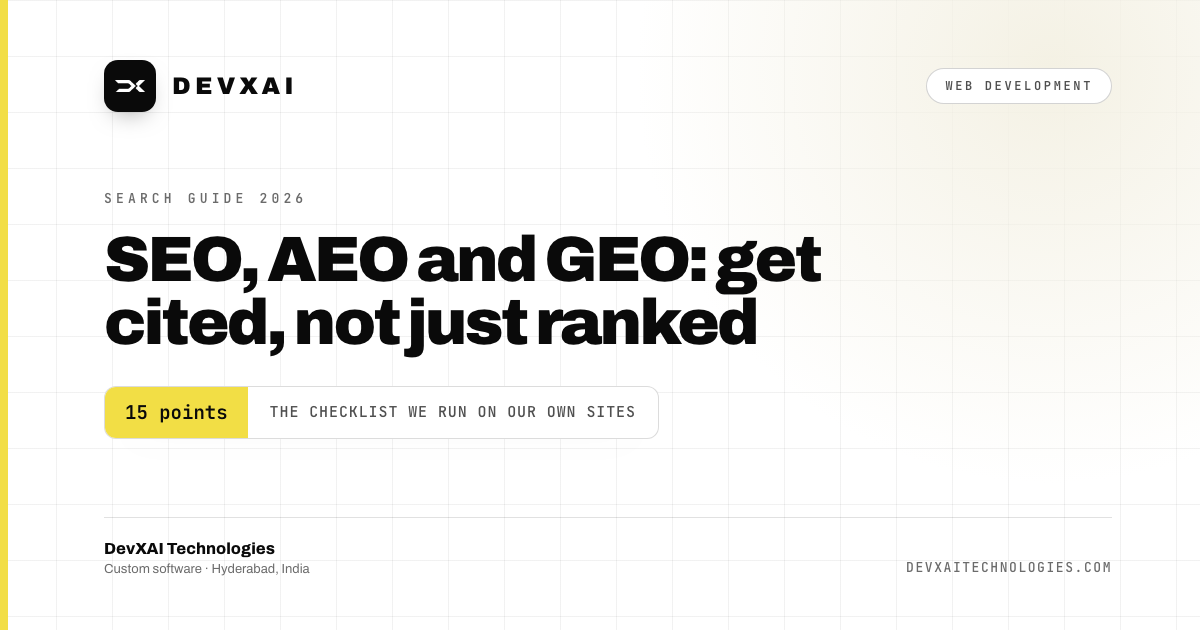
The 15-point checklist
Foundation: be crawlable and indexable
- Server-render the content. Many AI crawlers do not run JavaScript. If your article or price list appears only after a client-side fetch, they see an empty page. We moved this journal from client-side loading to server rendering for exactly this reason.
- Allow the crawlers you want answers from. Check robots.txt for GPTBot, OAI-SearchBot, ChatGPT-User, ClaudeBot, PerplexityBot, Google-Extended and Applebot-Extended. A named user-agent group does not inherit the rules under
User-agent: *, so repeat your Disallow lines in every group. - Keep a truthful sitemap. lastmod should change only when content changes. A sitemap where every URL claims it changed today teaches crawlers to ignore the field.
- Be fast and stable. Slow, error-prone pages get fetched less often and dropped from retrieval when a crawler is on a time budget.
AEO: write so a passage can be lifted
- Answer first. Open each page and each section with the direct answer in one or two sentences, then explain. "Website development in Hyderabad costs ₹1,20,000 to ₹4,50,000 for most business sites" beats three paragraphs of context.
- Use question-shaped headings that match how people ask, and answer each in the first sentence under it.
- Put comparisons in tables. Tables are the format assistants and featured snippets lift most cleanly.
- Add an FAQ with visible answers, and mark it up as FAQPage only if the answers are on the page.
GEO: make your brand an unambiguous entity
- Publish one Organization node with a stable
@idand reference it everywhere: articles, services, the about page. Five slightly different copies of your company in markup are five weak entities, not one strong one. - Connect your brands and people. Use
subOrganization,parentOrganizationandbrandto state who operates what, and attach authors to a realPersonnode. This site now marks every article about Stay Loud Studio or myFinance Wisdom with anaboutlink to that brand, which in turn names DevXAI as its parent. - Use the same name, address, phone and description everywhere: your site, Google Business Profile, LinkedIn, directories. Assistants reconcile entities by consistency.
- Publish original, specific facts. Prices, timelines, what is included and excluded, how a process works. A model can find generic advice anywhere. It cites the page that states something precise that others do not.
- Earn mentions elsewhere. Reviews, interviews, podcasts, directory listings, partner pages and community answers. For brand-recommendation questions, what others say about you outweighs what you say about yourself.
- Offer a machine-readable summary. An
/llms.txtgenerated from your real data costs almost nothing. Generate it, do not hand-write it: a hand-written copy drifts from your pages, and a summary that contradicts your site does more harm than none. - Keep it fresh and dated. Show a real published and updated date, and update pricing and "2026" guides when facts change. Assistants prefer recent sources for anything time-sensitive.
What does not work
- Hidden text or prompts aimed at AI crawlers. It is a spam signal for search engines, and assistants increasingly filter it.
- Mass-produced AI articles. Thin, interchangeable pages add nothing a model does not already know, so there is nothing worth citing. They also risk a site-wide quality demotion in Google.
- Schema that describes things not on the page. Google's guidelines single this out. Mark up what a visitor can see.
- Buying "AI ranking" packages. No one can sell a guaranteed placement in ChatGPT. Anyone who promises one is selling something else.
How to measure GEO
There is no Search Console for AI answers yet, so measure directly:
| Signal | How to track it | How often |
|---|---|---|
| Brand mentions in answers | A fixed list of 20 to 30 buyer questions, run in four assistants, recording named / cited / absent | Monthly |
| AI referral traffic | Sessions from chatgpt.com, perplexity.ai, gemini.google.com, copilot.microsoft.com in GA4 | Weekly |
| AI Overview presence | Search Console impressions on queries that show an AI Overview, plus manual checks | Monthly |
| Entity accuracy | Ask each assistant "What is [your brand]?" and correct the sources behind any wrong answer | Quarterly |
Where to start this week
- Check robots.txt and view your key pages with JavaScript disabled. Fix anything that disappears.
- Rewrite the first paragraph of your five most valuable pages so they answer the question directly.
- Write the 20 questions your buyers ask and run them through ChatGPT, Gemini and Perplexity. That list becomes your content plan.
DEVXAI · WEB PLATFORMS
A website that search engines and answer engines can both read.
We build server-rendered sites with a clean entity graph, generated llms.txt and structured data that matches the page. The same stack runs our own three brands.
Frequently asked questions
What is the difference between SEO, AEO and GEO?
SEO earns a ranked link in search results. AEO (answer engine optimisation) earns the direct answer: a featured snippet, a voice answer or a People Also Ask box. GEO (generative engine optimisation) earns a mention or citation inside an AI-generated answer from ChatGPT, Gemini, Perplexity, Copilot or Google AI Overviews. They build on each other: GEO without SEO rarely works.
Does llms.txt help my site appear in ChatGPT?
There is no public evidence that any major AI system ranks or cites sites because of llms.txt. It is a cheap, harmless proposal that gives AI tools a clean summary of your site, so it is worth adding if it is generated from your real content. It does not replace crawlable pages, structured data or being mentioned by other sources.
Should I block GPTBot and other AI crawlers?
Only if you do not want your content used by those systems. Blocking a search-oriented AI crawler such as OAI-SearchBot or PerplexityBot also removes you from the answers that crawler feeds. Most businesses that want to be recommended should allow the search crawlers and decide separately about training-only crawlers.
How do I know if AI assistants mention my business?
Ask them. Keep a fixed list of 20 to 30 questions a buyer would ask, run them monthly in ChatGPT, Gemini, Perplexity and Copilot, and record whether you are named, cited or linked. Also watch referral traffic from chatgpt.com, perplexity.ai and gemini.google.com in your analytics.
How long does GEO take to show results?
Changes to your own site can be picked up within weeks once the pages are recrawled. Being recommended by AI assistants depends more on third-party mentions, reviews and consistent entity data across the web, which typically takes months of steady work rather than a single project.
Topics
Found this useful?
Share it with your network.