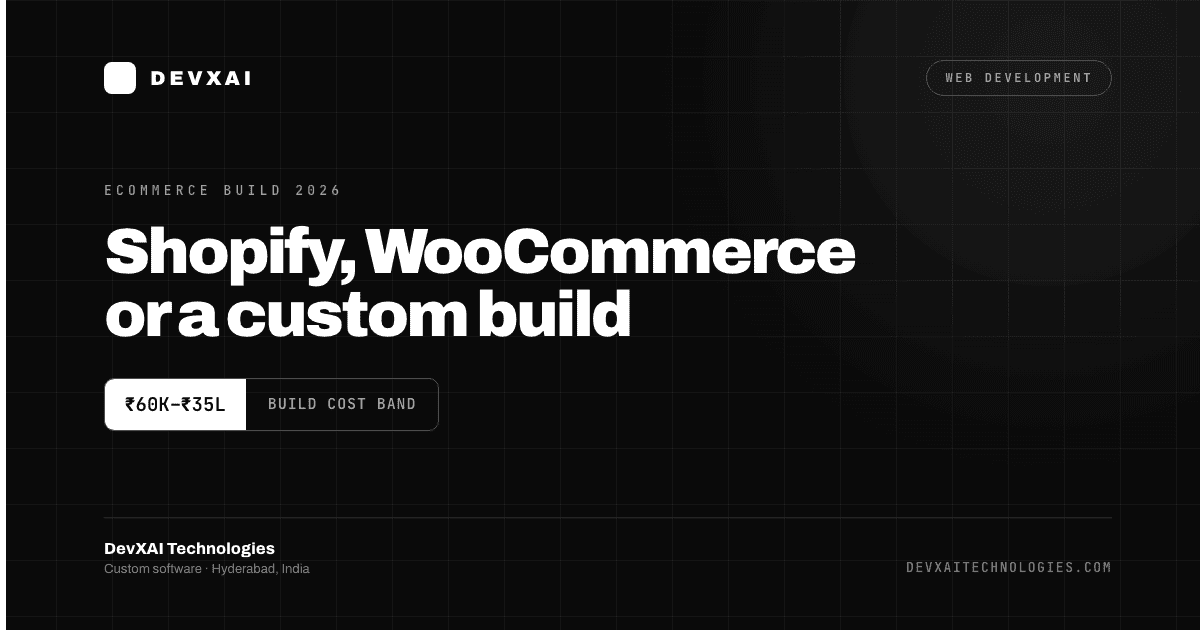
Ecommerce website development in India costs between ₹60,000 and ₹35,00,000 in 2026, and the spread has almost nothing to do with design. It is about how much control you need over checkout. A Shopify store on a paid theme goes live in three weeks. A build that handles partial COD advance, pincode serviceability and per-state GST invoicing takes four to seven months.
Most Indian D2C sellers do not need the custom build. Most Indian B2B sellers eventually do. This guide shows exactly where that line sits, in rupees, over five years.
Every price below is a DevXAI quoted range from Hyderabad in 2026. Platform fees are the vendors' own and they move, so confirm before you budget.
The short answer
Find the row that matches your order volume and your checkout rules.
| Your situation | Build this | Budget (DevXAI quote) | Live in |
|---|---|---|---|
| Under 300 orders/month, one warehouse, prepaid-heavy | Shopify Basic, paid theme, no custom code | ₹60,000 – ₹1,50,000 | 2–3 weeks |
| 300–3,000 orders/month D2C, heavy COD | Shopify or WooCommerce with a custom checkout and ops layer | ₹3,00,000 – ₹8,00,000 | 6–10 weeks |
| 5,000+ SKUs, content and SEO led | WooCommerce on managed infrastructure, hard performance budget | ₹4,00,000 – ₹9,00,000 | 8–12 weeks |
| B2B: GSTIN capture, tiered price lists, credit terms | Custom build on an open commerce engine | ₹12,00,000 – ₹28,00,000 | 4–7 months |
| Multi-vendor marketplace with seller payouts | Custom build, no shortcut exists | ₹18,00,000 – ₹35,00,000 | 5–9 months |
| Offline stores plus online, one live stock pool | Any of the above plus inventory middleware | add ₹4,00,000 – ₹10,00,000 | add 6–10 weeks |
Shopify, WooCommerce and a custom build, compared honestly
These are three trades, not three grades of one thing. Shopify sells speed and takes your checkout. WooCommerce sells control and hands you the maintenance bill. A custom build gives both and charges up front.
| Dimension | Shopify | WooCommerce | Custom / headless |
|---|---|---|---|
| Time to first live order | 2–3 weeks | 6–12 weeks | 4–9 months |
| Comfortable catalogue size | Tens of thousands of SKUs | Up to roughly 20,000 SKUs before search and facets need rework | No practical ceiling |
| Checkout control | Locked on lower plans, extensions only | Full, via PHP hooks | Full, it is your code |
| COD with partial advance | App-dependent and fragile | Buildable, two to three weeks of work | Native, part of the order model |
| Pincode serviceability at cart | App or script, usually blocks after add-to-cart | Buildable at product page level | Buildable anywhere, including search results |
| Multi-warehouse and split shipments | Basic locations, splits get awkward | Plugin territory, brittle past three warehouses | First-class, allocation rules you define |
| GST invoice per order and per state | App-generated, limited templates | Plugin plus custom fields | Exact, tied to place of supply |
| Who should pick it | D2C brands under roughly ₹5 crore GMV | SEO-led catalogues and content commerce | B2B, marketplaces, multi-entity sellers |
Where Shopify wins, and where you should not hire an agency
If you are doing under 300 orders a month with one warehouse and a mostly prepaid customer, do not commission a build. Buy a ₹15,000 theme, spend a weekend on product photography, connect Razorpay or Cashfree, and put the ₹4,00,000 you saved into performance marketing and packaging. Come back when operations start breaking. That is a problem code solves.
Where WooCommerce wins
WooCommerce is still right for catalogue-heavy, content-led sellers: industrial parts, books, spares, chemicals, anything where organic search does most of the selling. You own the database and pay no per-order platform tax. The cost is hosting and discipline. An unmaintained WooCommerce store with 34 plugins is the most expensive website in India.
Where a custom build is the only answer
Any one of these is enough on its own.
- Your pricing is per customer rather than per product, which is normal in B2B distribution.
- An order is not one event, so you carry quotations, part shipments and credit terms.
- Checkout must enforce a rule the platform has no concept of, such as blocking COD above ₹5,000 in specific pincodes unless the buyer pays a ₹300 advance.
At that point every workaround is an app that breaks during your Diwali sale. DevXAI's ecommerce platform engineering work is almost entirely this third case.
The five-year cost of ecommerce website development in India
Build cost is what everyone compares and what matters least. Model five years. The table assumes a mid-sized Indian D2C seller:
- 2,500 orders a month at an average order value of ₹1,500.
- ₹4.5 crore of GMV a year, ₹22.5 crore over five years.
- Payment gateway MDR excluded, because it is roughly the same whichever platform you pick.
| Cost line (5 years) | Shopify | WooCommerce | Custom / headless |
|---|---|---|---|
| Initial build | ₹1,50,000 – ₹4,00,000 | ₹2,50,000 – ₹6,00,000 | ₹12,00,000 – ₹35,00,000 |
| Platform plan or licences | ₹4,50,000 | ₹4,50,000 | ₹0, open-source engine |
| Apps and extensions | ₹6,00,000 | included above | ₹0 |
| Hosting and cloud | included | ₹9,00,000 | ₹18,00,000 |
| Platform fee on gateway-settled orders | ₹11,00,000 – ₹22,50,000 | ₹0 | ₹0 |
| Maintenance and engineering | ₹3,00,000 | ₹12,00,000 | ₹24,00,000 |
| Five-year total | ₹26,00,000 – ₹40,00,000 | ₹28,00,000 – ₹31,50,000 | ₹54,00,000 – ₹77,00,000 |
Check the platform-fee row first. Shopify Payments is not offered to merchants in India, so an Indian store runs Razorpay or Cashfree and pays Shopify a fee on top of the gateway's own charge. For an Indian seller that row is never zero. It steps down as you move up plans and lands only on orders settled through a gateway, not on COD collected offline, so your prepaid share moves it too. Confirm the current rate for your plan.
At ₹4.5 crore of GMV a custom build never pays for itself on saved fees. It pays back when the platform costs you orders or headcount. If 4% of COD-inclined buyers abandon because you cannot take a ₹200 advance, that is ₹18,00,000 of GMV a year, and at a 35% contribution margin roughly ₹31,50,000 over five years. One rule can close a large part of that gap. If you cannot name a leak like that in numbers, you are not ready for a custom build. The same arithmetic runs through the Hyderabad website development cost breakdown.
FIXED-PRICE QUOTE
Get your ecommerce build priced in INR
Send your catalogue size, monthly orders and COD share. Within one working day you get a scope, a timeline and a fixed price in INR, including the checkout and GST work most quotes omit.
The checkout wall every Indian seller hits
Almost every Indian ecommerce project DevXAI has taken over broke in the same place. Not the catalogue. Checkout. Five rules do it, and none exist in a platform built for a card-paying buyer in Ohio.
- Cash on delivery, conditionally. You want COD for a first-time buyer in Vijayawada, not for the pincode that returned eleven parcels last month. The rule is per pincode, per category, per order value, and it changes weekly.
- Partial COD advance. Collecting ₹100 to ₹300 on UPI before dispatch is the most effective return-to-origin control in Indian D2C. It needs one order with two payment states, which most platforms model badly.
- Pincode serviceability. Telling a buyer on the product page that you cannot deliver to 500081 beats telling them after they type an address. It needs a cached courier lookup, because that API is slow.
- GST-correct invoices. The invoice carries your GSTIN, the HSN code and the right tax split. Intra-state supply is CGST plus SGST, inter-state is IGST, and place of supply for goods follows the delivery address. Get that wrong across a few thousand orders and reconciliation becomes manual.
- B2B GSTIN capture. A business buyer needs their GSTIN on the invoice to claim input tax credit. No field for it in checkout means you have quietly excluded every B2B customer.
E-invoicing thresholds have come down in stages, so check the current notification for your turnover band rather than assuming you are exempt. This is not legal or tax advice; confirm specifics with your CA before anyone hard-codes tax logic. The architectural point holds either way: tax rules change, so keep them in configuration, never in checkout code.
Payments and logistics decide your margin, not your theme
UPI has carried no merchant discount rate in India since 2020, a structural advantage no Western market has. Treat that as current policy rather than permanent: charges on merchant UPI payments are under active review in 2026, so check the current notification before you model five years of margin on free UPI. Cards and netbanking are typically quoted around 2%, plus 18% GST on the fee. Every point of UPI share you win is margin, so build for it:
- UPI intent as the default, pre-selected option on mobile, not a tab below cards.
- Saved VPAs for repeat buyers, and a QR fallback on desktop.
- Order confirmation that does not wait on a webhook arriving 40 seconds later.
The detail work is covered in this guide to UPI payment gateway integration in India.
On logistics, decide early whether you aggregate or integrate directly. Shiprocket and similar aggregators put many couriers behind one API, the right call under roughly 3,000 shipments a month. Past that, direct integrations with Delhivery and Blue Dart get better rates and better status webhooks. Either way the storefront must not talk to couriers. Put an API and integration layer between them, so switching courier is a config change.
Multi-warehouse is the quiet cost multiplier. Two warehouses, say Hyderabad and Bhiwandi, means allocation rules, split shipments, split invoices and split returns. Never add a warehouse and a platform in the same quarter.
The operations layer nobody puts in the quote
A storefront is maybe 40% of an Indian ecommerce build. The rest is machinery behind it, and if that is missing the founder is the machinery.
- Returns and RTO. In our book of work, COD return-to-origin runs between 15% and 35% depending on category and pincode mix, against low single digits on prepaid. You need RTO reasons captured, restocking that puts the unit back into sellable inventory, and a pincode blocklist that learns.
- COD reconciliation. Couriers remit in batches, typically eight to fifteen days after delivery, minus a collection fee. Someone matches every remittance line to an order. Automate it on day one or hire a person for Excel.
- GST invoicing per order. Generated at dispatch, numbered in an unbroken series per place of business, and exportable in the format your CA actually wants.
- Offline inventory sync. If a shop in Banjara Hills and a warehouse both feed the website, they need one stock pool with reservation logic, not a nightly CSV. That is an ERP integration, not a storefront feature.
Reconciliation and RTO triage are also the highest-return place to put machine learning in an Indian store, long before product recommendations, as set out in this piece on AI automation for Indian businesses.
Your real test device is a ₹12,000 Android on 4G
Your customer in Kondapur is not on a MacBook over fibre. She is on a mid-range Android with a slow CPU, on 4G that crawls indoors. Test there. In Hyderabad we keep three budget handsets on the desk, because a store that feels instant in HITEC City takes eight seconds to first paint in Warangal.
Core Web Vitals in 2026 are Largest Contentful Paint at or under 2.5 seconds, Interaction to Next Paint at or under 200 milliseconds, and Cumulative Layout Shift at or under 0.1. On budget Android, INP fails first, because JavaScript parse and execution cost scales with CPU weakness. A workable product-page budget:
- Under 200KB of compressed JavaScript on the critical path. Most stores we audit ship over a megabyte once apps are added.
- AVIF or WebP images sized per breakpoint, hero product image preloaded and never lazy-loaded.
- Reserved dimensions on every image and banner slot, which is most of CLS solved.
- Analytics, chat and pixel scripts deferred or moved server-side.
Ecommerce SEO: product schema, facets and crawl budget
Three things matter more than a blog, and all three are structural.
- Product structured data on every product page: offers, price in INR, currency, availability, kept accurate. Marking an out-of-stock item InStock is how you earn a manual action. Include aggregateRating only if the reviews are real and on the page.
- Faceted navigation, where large Indian catalogues quietly die. Colour, size, brand and price filters multiply into millions of URLs, Googlebot crawls them, and your real category pages stop getting crawled.
- Core Web Vitals, for the reason in the section above. A store failing INP loses conversions before it loses rankings.
The facet fix: one indexable path per intent, filter combinations canonicalised to the clean category URL, filter parameters kept out of internal links, and a facet promoted to its own page only when people search that colour or brand.
FREE 30-MINUTE AUDIT
Find out what your current store is leaking
Send your live store URL. We run it on a budget Android over 4G, check your product schema and facet crawl paths, and tell you in 30 minutes where the orders are leaking. No pitch deck.
Book the free audit or call +91 91605 52516.
Frequently asked questions
How much does ecommerce website development in India cost in 2026?
A Shopify store on a paid theme is ₹60,000 to ₹1,50,000. A D2C store with a custom checkout, COD rules and GST invoicing is ₹3,00,000 to ₹8,00,000. A custom or B2B build runs ₹12,00,000 to ₹35,00,000. Those are DevXAI's 2026 Hyderabad quotes, before platform and gateway fees.
Is Shopify or WooCommerce better for an Indian D2C brand?
Shopify, if you are under roughly 300 orders a month and want to sell this month. WooCommerce, if you have thousands of SKUs, depend on organic search, or need checkout logic Shopify will not let you write. Shopify costs less to run and more per order.
Can I collect a partial COD advance on Shopify?
Only through apps, and the experience is fragile, because Shopify models one payment per order. If a partial advance is central to controlling your return-to-origin rate, build the checkout yourself on WooCommerce or a custom stack. Two payment states on one order is a data model decision.
Do I need a custom build to issue GST-compliant invoices?
No. Apps and plugins handle single-state, single-GSTIN B2C selling adequately. Custom work becomes necessary when you have multiple places of business, B2B buyers supplying a GSTIN for input tax credit, or an ERP that must own the invoice series. Confirm specifics with your CA first.
How long does an Indian ecommerce build take end to end?
Two to three weeks for a themed Shopify store. Six to twelve weeks for WooCommerce with real checkout and operations work. Four to nine months for a custom or marketplace build. Add six to ten weeks if you are syncing live inventory with offline stores.
What to do next week
Before talking to any vendor in Hyderabad, Bengaluru, Chennai, Mumbai or Pune, write down four numbers: monthly orders, average order value, SKU count, COD share. Those decide the platform. The rest is preference.
Then ask each shortlisted agency these questions. How will you handle COD partial advance and pincode serviceability. Who owns the code and the repository on day one. What breaks at ten times my order volume. A vendor who answers the third one with a straight face is worth talking to. One who says "no problem" is not. The delivery process and the care plans set out how a build is supported after launch.
Send those four numbers across and DevXAI will run this arithmetic on them. The team works IST hours from the Financial District in Hyderabad, for sellers across India from Vijayawada to Mumbai.
Topics

TEAM DEVXAI
Written and published by the engineering, product design, and AI systems team at DevXAI Technologies.
Found this useful?
Share it with your network.